
A flock of birds rises over the olive groves of southern Spain at dawn, chasing a man hanging from a paraglider. From the seat of the aircraft a woman is singing to them in German. The birds know the tune. They follow it the way you would follow a voice you trusted as a child.
That is the photo that just won Nature's 2026 Scientist at Work competition, and the moment I saw it I knew I had to write about this one.
I spend my life trying to be in the right place when the ocean does something most people never get to see. So I have a soft spot for photographers who do the same thing for science: stand in the cold, the deep, or the dark long enough to bring back one frame that makes the rest of us feel something. This year's five winners do exactly that. Now in its seventh year, the competition pulled more than 220 entries from researchers all over the world, and these are the five that landed.
The birds that follow a song
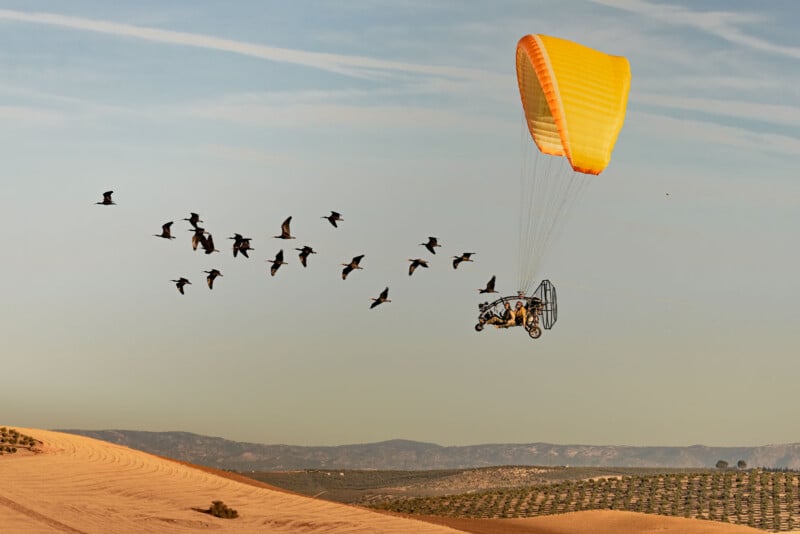
The northern bald ibis disappeared from the foothills of the Alps around 400 years ago, hunted out and pushed away by a changing climate. A group called the Waldrappteam has spent two decades teaching them how to come back. They hand-raise the birds, the birds bond to their human foster parents, and then every year the team flies an ultralight aircraft 2,800 kilometers across 50 days, from southeast Germany to southwest Spain, with the whole flock following the sound of a familiar voice.
Gunnar Hartmann, a science undergraduate at the University of Koblenz in Germany, joined the migration in 2024 to help plan the route and document the journey. His job, in other words, was mine: be there, and bring it home. He beat more than 220 other entries to take the top prize.
A quiet moment on a busy reef
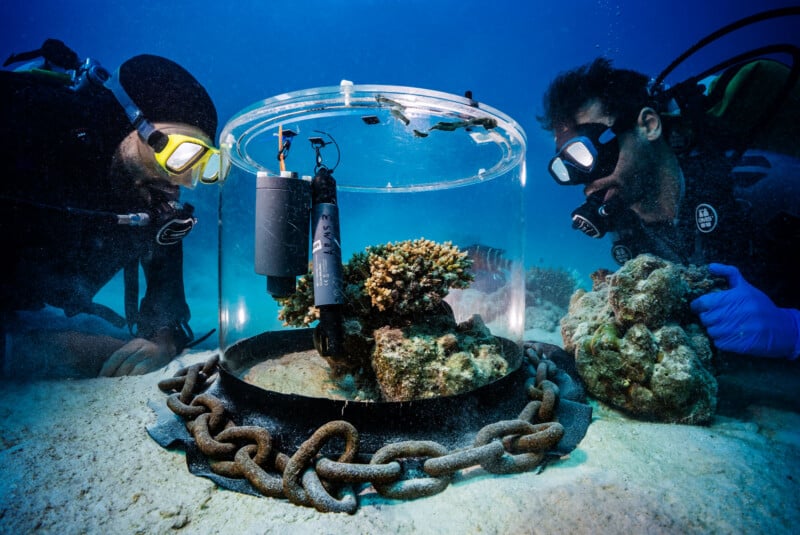
Off the Saudi Arabian coast, researchers Nauras Daraghmeh and Yusuf El-Khaled lower a glass chamber over a patch of living reef. The project is nicknamed the "coral probiotics village," run out of King Abdullah University of Science and Technology, and it studies how corals are coping with water that keeps getting warmer. The chamber measures the oxygen the corals and their tiny resident algae breathe in and out, the quiet machinery of a reef trying to survive.
Freelance marine biologist Uli Kunz shot it. "In this photo, I wanted not only to capture the research divers in the midst of their often hectic work, but also to show a moment of quiet contemplation," he said. Anyone who has worked underwater knows how rare that stillness is. You fight for it.
Eye to eye with a gentle giant
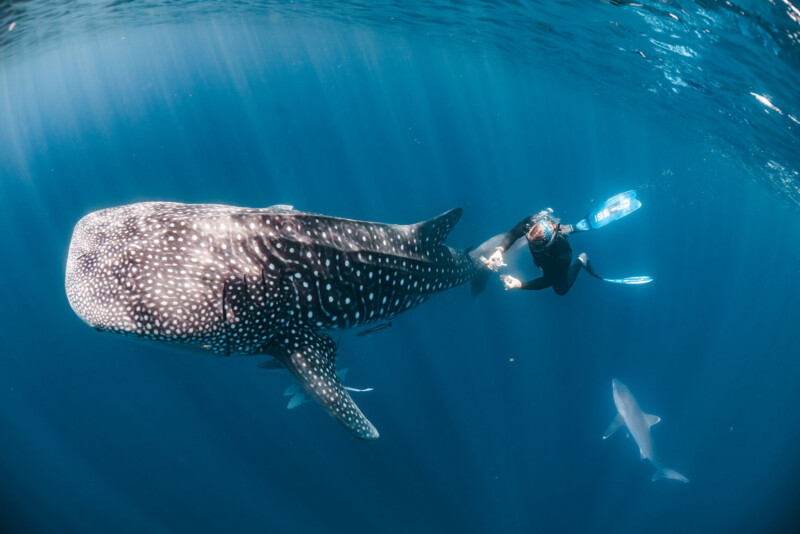
This is the one I keep coming back to. On a single breath, marine biologist Michael Doane drops down and skims the skin of a 12-meter whale shark with a syringe, collecting the microbes that live on it. Behind him, a silvertip shark slides into the frame. Marine ecologist Robert Harcourt, from Macquarie University, was there to document it, off Ningaloo Reef in Western Australia.
"Swimming next to a 12-metre whale shark as it cruises through the blue, gulping away and seemingly non-plussed by our presence is both humbling and exhilarating," Harcourt said. "The silvertip shark sneaking up on Mike got all our hearts racing, except Mike, who was focused on microbes." That last line is the whole job, isn't it. The ocean throws everything at you, and you stay on the shot.
Beautiful from above, awful up close
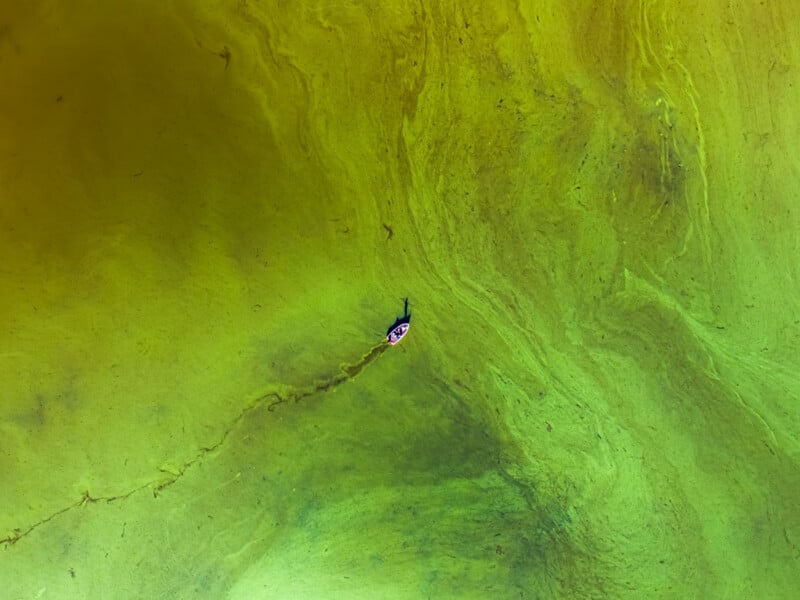
From above, the green swirls on Dog Lake in Ontario look like marbled paint. Up close they are a vile-smelling layer of rot that kills fish and clogs water supplies every summer. Haolun (Allen) Tian, a PhD student at Queen's University in Canada, flew the shot while his team collected samples from a small pink boat. They study the bloom's DNA to understand how it tangles with the rest of the lake's life. The photo is a reminder that beauty and damage often wear the same colors, and that perspective is everything. Same scene, two completely different truths.
The smallest subject in the room

The last winner trades the open world for a dark lab. Entomologist Lee Haines studies a yellow fever mosquito under ultraviolet light, part of research into a drug that can kill blood-feeding insects. Shayanta Chowdhury, a chemistry student at Notre Dame, made the photo. "The UV illumination created striking colors from both the tiny mosquito and the condensation that formed beneath the cold Petri dish," he said. He does not even work with biological samples himself. He just saw something beautiful and chased it. I respect that more than I can say.
Why these stay with me
There is a thread running through all five. None of these photographers were chasing a trophy. They were doing the work, paying attention, and ready when the moment arrived. That is the part people never see about this kind of photography. The shot is the easy ten percent. The other ninety is showing up, again and again, in places that are cold or deep or dark or just plain uncomfortable, and trusting that something worth keeping will happen if you stay long enough.
It is the same reason I keep paddling out before the sun is up. The ocean does not perform on a schedule, and neither does a flock of ibises or a curious shark. You just have to be there, hands ready, when the light arrives.
Photos by Gunnar Hartmann, Uli Kunz, Rob Harcourt, Haolun (Allen) Tian, and Shayanta Chowdhury, all from Nature's 2026 Scientist at Work photo competition.